Education and Challenges of the Contemporary World: The way Forward
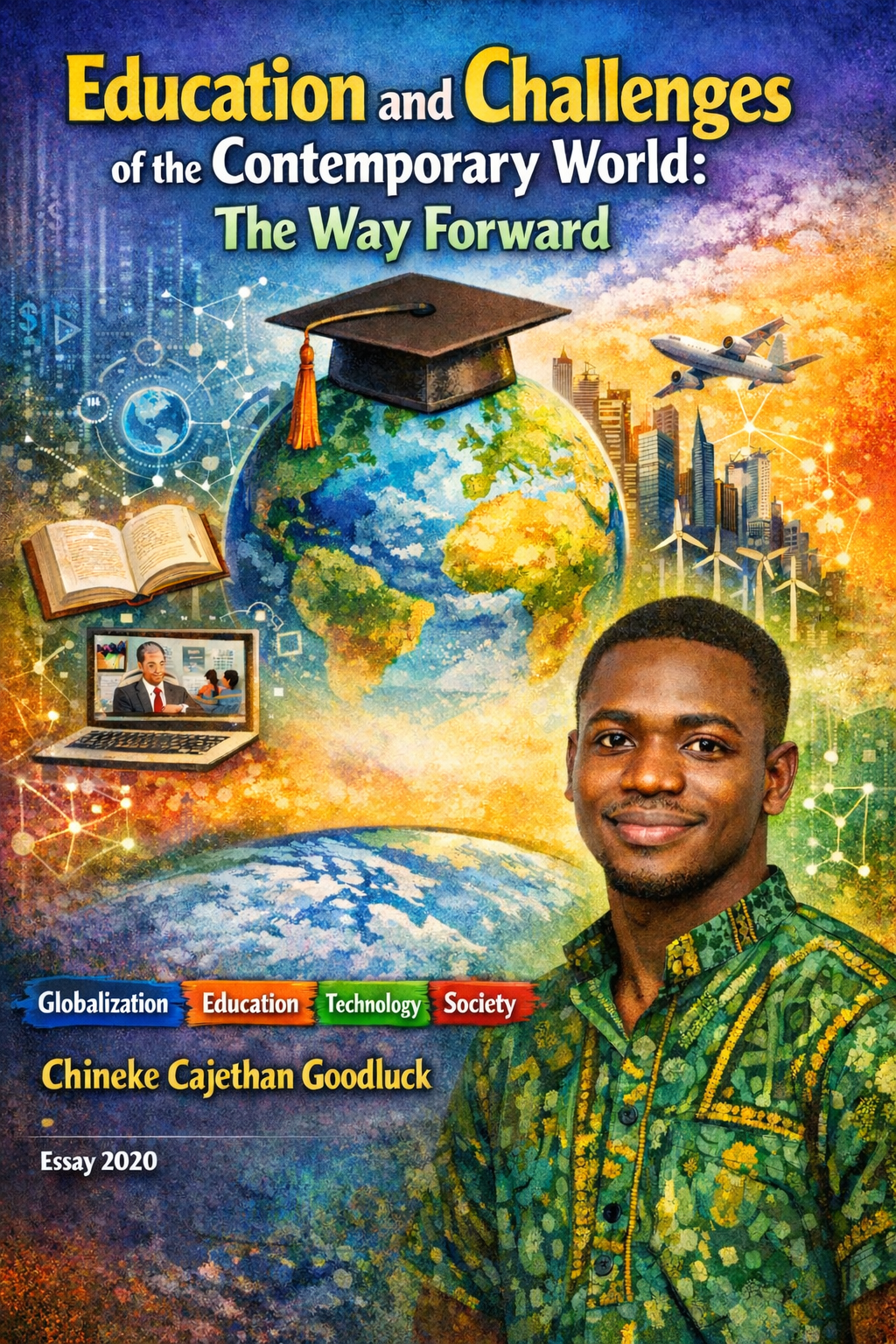
Education and the Challenges of the Contemporary World: The Way Forward
The word “globalization” is on everyone’s lips. It has rapidly evolved into a slogan, a powerful mantra, and even a symbolic “passport” believed to unlock solutions to present and future global challenges. Across disciplines and policy debates, education consistently emerges as the central lifeline for addressing these challenges. It is not only a key component of economic policy but also an integral part of social life, institutionalized and embedded within national budgets.Education and culture sustain hope. They provide a pathway for individuals and societies to rise from disadvantaged conditions toward more advanced and dignified states of existence. In today’s increasingly complex and dynamic world—whether acknowledged or not—global realities continue to reshape social spaces and human destinies at an unprecedented pace.
1. Globalization and Education
Globalization is an undeniable phenomenon that profoundly influences the systems of every nation. At its core, it reflects a process through which the world is gradually transforming into an interconnected “global system”—economically, politically, socially, and culturally. This transformation carries significant implications for education.The 20th century stands as one of the most dynamic and contradictory periods in human history. It witnessed remarkable achievements—technological advancements that compressed time and space—alongside devastating global crises such as wars, ideological conflicts, and widespread poverty. It was truly a “century of extremes.”Today, globalization represents a “world in motion.” It is an abstract and complex concept, difficult to quantify or define with precision. As Braila (2001) suggests, globalization does not arise from a single cause but from multiple interacting forces.The term gained prominence in the late 1960s through thinkers such as Marshall McLuhan, who introduced the idea of the “global village,” and Zbigniew Brzezinski. In this global village, events across political, economic, and cultural spheres are increasingly interconnected and mutually influential.Globalization can be understood through several dimensions:
- Global interdependence: Increasing interconnectedness across nations.
- Expansion of domination and dependence: Power relations extending across economies, politics, and cultures.
- Homogenization: The blending or standardization of cultures and systems.
- Local diversification: Adaptation and variation within local contexts.
- Temporal unification: The synchronization of global activities across time and space.
Despite these developments, globalization remains marked by inequality, with the global system resembling a mosaic of states whose interests may converge or diverge.
2. The Impact of Globalization on Education
Globalization has significantly reshaped the foundations of education. Scholars such as Donald J. Boudreaux (2008) argue that economic globalization and the information revolution have transformed teaching and learning, even suggesting a trend toward deinstitutionalization.The diversification and fragmentation characteristic of global society challenge traditional national education systems. Increasingly, education is influenced by global economic competition, with a growing emphasis on skills certification and adaptability. Virtual learning environments now compete with traditional classroom models, reshaping how education is delivered.One major consequence is the internationalization of education, reflected in the mobility of students and teachers through programs such as Erasmus, Comenius, and Tempus. Policymakers frequently adopt and adapt educational reforms from other countries, fostering a global exchange of ideas.International organizations—including UNESCO, OECD, CEDEFOP, and the World Bank—play crucial roles in shaping education policy worldwide. They promote collaboration, standardization, and innovation in educational systems.According to Marcelo Suárez-Orozco, globalization is characterized by:
- Increased migration,
- The widespread influence of technology,
- The globalization of production and services,
- Continuous cultural exchange across borders.
However, he notes a critical gap: education systems often fail to adequately address the realities of globalization. Modern learners must process vast amounts of information and develop versatile skills, including critical thinking and problem-solving.Higher education institutions now operate in a highly competitive global environment, striving to attract talented students and improve rankings based on performance, infrastructure, and research output.Technological advancements—such as the internet, e-learning platforms, and video conferencing—have revolutionized education, enabling learning beyond geographical and temporal constraints. Distance learning, in particular, has become increasingly popular among working professionals and non-traditional students.Despite these changes, the role of the teacher remains indispensable. Technology cannot fully replace the human element in education, especially in fostering critical thinking, creativity, and intellectual engagement.Globalization has also elevated the importance of language. While English dominates as a global medium, linguistic diversity should be embraced as a source of cultural and intellectual enrichment.Educational innovation continues to expand, introducing new methodologies, leadership training, environmental awareness programs, and entrepreneurship education. These developments promote values such as inclusivity, multiculturalism, and respect for human rights.In modern education, the teacher’s role is evolving—from a transmitter of knowledge to a facilitator of learning. Emphasis is now placed on guiding students to discover, analyze, and apply knowledge independently.
3. Conclusion
Education remains a cornerstone of modern society and economic development. It drives innovation, enhances social cohesion, and supports individual growth and self-realization. In an era defined by rapid change, education must continuously adapt to meet emerging global demands.Collaboration among stakeholders—governments, institutions, communities, and industries—is essential for building effective and responsive education systems. Through such partnerships, education can foster global awareness and mutual understanding across cultures and societies.Ultimately, education in a globalized world must promote a holistic vision of human development—one that transcends geographical, cultural, and economic boundaries. It must cultivate individuals who are not only knowledgeable but also capable of coexistence, innovation, and ethical responsibility.
The four fundamental pillars of education
- learning to know,
- learning to do,
- learning to live together, and
- learning to be
It must be reinterpreted and strengthened to address the realities of the contemporary world.