How we can use our Connections for Positive Changes.

How we can use our Connections for Positive Changes.

Today, we have sent human beings beyond the reaches of Earth's atmosphere; we have stood on the surface of the moon. Yet, reading this poem, one has to wonder if people in ancient times didn't sense the presence of the moon and stars more intimately than we do today. Is it possible they lived richer, more expansive lives than we, who for all our material comfort, rarely remember to look up to the sky?

Immersed in material concerns, clamor and bustle, contemporary humanity has been cut off from the vastness of the universe, from the eternal flow of time. We struggle against feelings of isolation and alienation. We seek to slake the heart's thirst by pursuing pleasures, only to find that our cravings have grown that much fiercer.

This separation and estrangement is, in my view, the underlying tragedy of contemporary civilization. Divorced from the cosmos, from nature, from society and from each other, we have become fractured and fragmented.

Science and technology have given humanity undreamed of power, bringing invaluable benefits to our lives and health. But this has been paralleled by a tendency to distance ourselves from life, to objectify and reduce everything around us to numbers and things.Even people become things.

 The victims of war are presented as statistics; we are numbed to individual realities of unspeakable suffering and grief.

The eyes of a poet discover in each person a unique and irreplaceable humanity. While arrogant intellect seeks to control and manipulate the world, the poetic spirit bows with reverence before its mysteries.

Human beings are each a microcosm. Living here on Earth, we breathe the rhythms of a universe that extends infinitely above us. When resonant harmonies arise between this vast outer cosmos and the inner human cosmos, poetry is born.

At one time, perhaps, all people were poets, in intimate dialogue with Nature. In Japan, the Manyoshu collection comprised poems written by people of all classes. And almost half of the poems are marked "poet unknown."

These poems were not written to leave behind a name. Poems and songs penned as an unstoppable outpouring of the heart take on a life of their own. They transcend the limits of nationality and time as they pass from person to person, from one heart to another.

The poetic spirit can be found in any human endeavor. It may be vibrantly active in the heart of a scientist engaged in research in the awed pursuit of truth. When the spirit of poetry lives within us, even objects do not appear as mere things; our eyes are trained on an inner spiritual reality. A flower is not just a flower. The moon is no mere clump of matter floating in the skies. Our gaze fixed on a flower or the moon; we intuitively perceive the unfathomable bonds that link us to the world.

In this sense, children are poets by nature, by birth. Treasuring and nurturing their poetic hearts, enabling them to grow, will also lead adults into realms of fresh discovery. We do not, after all, exist simply to fulfill desires. Real happiness is not found in more possessions, but through a deepening harmony with the world.The poetic spirit has the power to "retune" and reconnect a discordant, divided world.

 True poets stand firm, confronting life's conflicts and complexities. Harm done to anyone, anywhere, causes agony in the poet's heart.

A poet is one who offers people words of courage and hope, seeking the perspective - one step deeper, one step higher - that makes tangible the enduring spiritual realities of our lives.

The apartheid system of racial segregation was a grave crime against humanity. In resisting and combating this evil, the keen sword of words played an important role.

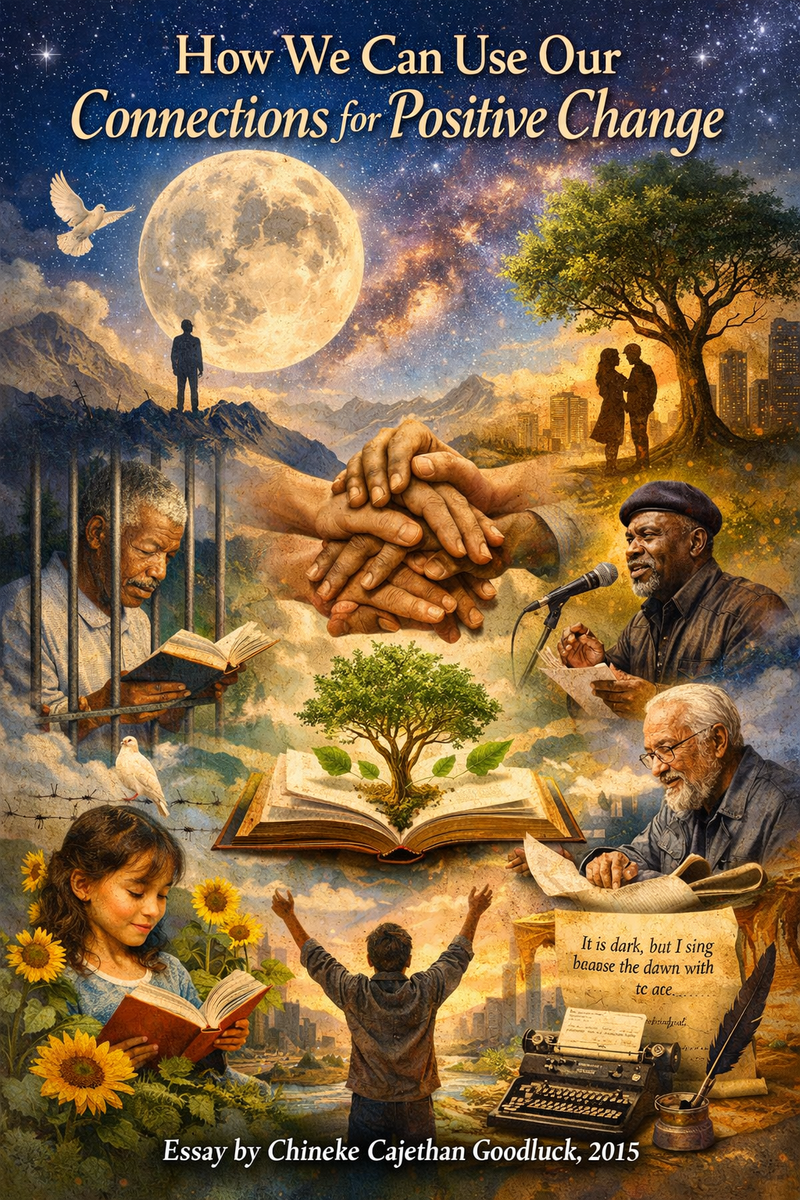
Oswald Mbuyiseni Mtshali is a South African poet who fought against the iniquities of apartheid with poetry as his weapon. He writes: "Poetry reawakens and reinforces our real, innermost strength; our spirituality. It is the force that makes us decent people, people who are filled with empathy for those in need or pain, those suffering from injustice and other wrongs or societal ills." Nelson Mandela read Mtshali's poems in prison, drawing from them energy to continue his struggles.

The Brazilian poet Thiago de Mello, lauded as the protector of the Amazon, also endured oppression at the hands of the military government. On the wall of the cell in which he was imprisoned, he found a poem inscribed by a previous inmate: "It is dark, but I sing because the dawn will come." They were words from one of his own poems.

Amid the chaos and spiritual void that followed Japan's defeat in World War II, like many young people of my generation; I gained untold encouragement from reading Walt Whitman's "Leaves of Grass." The overflowing freedom of his soul struck me like a bolt of empathetic lightning.

Now more than ever, we need the thunderous, rousing voice of poetry. We need the poet's impassioned songs of peace, of the shared and mutually supportive existence of all things. We need to reawaken the poetic spirit within us, the youthful, vital energy and wisdom that enable us to live to the fullest. We must all be poets.

An ancient Japanese poet wrote, "Poems arise as ten thousand leaves of language from the seeds of people's hearts."

Our planet is scarred and damaged, its life-systems threatened with collapse. We must shade and protect Earth with "leaves of language" arising from the depths of life. Modern civilization will be healthy only when the poetic spirit regains its rightful place.

Essay By Chineke, Cajethan Goodluck. 2015

Read More  
“A Just and Lasting Peace: More than the Absence of War”.

“A Just and Lasting Peace: More than the Absence of War”.

The lives and prosperity of millions of people depend on peace and, in turn, peace depends on treaties, fragile documents that must do more than end wars. Negotiations and peace treaties may lead to decades of cooperation during which disputes between nations are resolved without military action and economic cost, or may prolong or even intensify the grievances which provoked conflict in the first place. In 1996, as Canada and the United States celebrated their mutual boundary as the longest undefended border in the world, Greece and Turkey nearly came to blows over a rocky island so small it scarcely had space for a flagpole.1 Both territorial questions had been raised as issues in peace treaties. The Treaty of Ghent in 1815 set the framework for the resolution of Canadian-American territorial questions. The Treaty of Sevres in 1920, between the Sultan and the victorious Allies of World War I, dismantled the remnants of the Ottoman Empire and distributed its territories. Examination of the terms and consequences of the two treaties clearly establishes that a successful treaty must provide more than the absence of war.

How do the terms or implementation of treaties determine peace or conflict decades later? Efforts to build a just and lasting peace are complicated not only because past grievances must be addressed, but future interests must be anticipated even when such future interests were not identified as the cause of war in the first place. Edward Teller, discussing the Manhattan Project, observed, "No endeavor which is worthwhile is simple in prospect; if it is right, it will be simple in retrospect." Only if a nation perceives that continuing observance of the treaty will sustain the state over a long period of time and in changing circumstances, the peace and security promised by the treaty will endure. Machiavelli observed that”  fear of loss of the State by a prince or republic will overcome both gratitude and treaties."

The Treaty of Ghent supports the notion that the essential long-term national interests of both parties are the most important factor in peace treaty success. Both the United States and Great Britain clearly perceived that they had real grievances and cause for war in 1812. However, within a short time, both nations realized they had a greater interest in peace without regard to most of the issues that provoked the conflict.

The United States, initially focusing on the infringement of its maritime rights and customs and commercial trade, specifically objected to impressments of its merchant seamen, and worried that the nation might be forced to fight a second war of independence if Britain did not recognize the rights of its citizens. The English sought, primarily, to "rectify" the border between Canada and the United States, establish a native American buffer around the Great Lakes, and secure Canada from invasion by land-hungry Americans.

The Americans initiated mediation through a third party, Czar Alexander I of Russia, who organized delegations to both countries while hostilities were in progress. Direct negotiations began in 1814. By the time the Treaty was negotiated, Americans refocused on territorial security as their principal concern, while the British conceded any jurisdiction over American commerce and merchantmen to concentrate military resources in Europe. The initial demand of the Americans, the end of impressments, was also conceded without proclamation. The territorial settlement restored the status quo ante bellum despite the fact that the British had captured Washington and the Americans had achieved naval supremacy on the Great Lakes. Arrangements to pay for destroyed property were included with ambiguous terms for reparations. Both countries agreed to work toward abolishing the slave trade, and agreed to respect Indian rights. Most importantly, boundary commissions were established by the treaty, which made possible the peaceful and rapid resolution of future conflicts.

In 1815, the Treaty of Ghent stood a good chance of success because neither side could gain more by continuing the military conflict in view of other pressing interests. Despite the fact that Great Britain maintained the strongest navy in the world and could have reduced America to its former status as a de facto colony, the English remained concerned about the threat by the French to shipping in the English Channel. By the time the treaty was ratified, only six weeks after it was signed, Napoleon was on the march again and the Americans had won the Battle of New Orleans. The strategic picture had changed for both countries in a matter of weeks. Both nations, however, recognized mutual benefits, and what became the essential goals of each nation dictated that the Treaty of Ghent be ratified and enforced.

Perhaps most interesting, shortly after the War of 1812 was resolved, the British mercantile interests in the West Indies began to decline in relative terms and that nation's commercial interest in American cotton became more significant. Boundary issues and Indian rights became less important than a source of raw materials for industries in England. This was a change in the parties' interests that was not anticipated, but explained their willingness to settle on a stable national boundary.

In comparison to the Treaty of Ghent, the Treaty of Sevres can only be described as a short-term success and a long-term disaster. Signed in August 1920 by the representatives of Ottoman Turkey and the Allies of World War I, the treaty dismantled the Ottoman Empire for the benefit of various groups indigenous to the area and, not least of all, British, French, and Italian interests in the Middle East. France received a mandate in Syria, and Britain in Palestine and Iraq. Italy demanded Montenegro as a buffer between its territories and Serbia. Turkey gave up its rights to North Africa and the Arabian Peninsula. Kurdestan and Armenia became autonomous. Greece dominated eastern Thrace, the Anatolian west coast, and most Aegean islands. The British, French, and Italian governments controlled the Turkish treasury.

The peace imposed on a captive Sultan did not demand indemnities, but the Turks believed the Treaty of Sevres was so unfair that Mustafa Kemal threatened to overthrow the Sultan. As Allies debated the use of military force to guarantee the Treaty, the United States refused to participate. The Sultan refused to ratify the Treaty, believing his government could not survive if he signed. In 1921, Kemal signed an agreement with Bolshevik Russia which crushed Armenian independence. The Treaty of Sevres rapidly crumbled.

The Treaty of Ghent, unlike the Treaty of Sevres, met the mutual national interest of warring parties, avoided onerous provisions, and was quickly implemented. In 1920, however, the diverse interests represented by the Allies and groups within the old Ottoman Empire made it impossible to identify essential interests and satisfy the most disaffected parties. France sought terms for a greater Syria and signed a separate treaty with Kemal, acting as foreign minister of Turkey. Great Britain supported the Sultan's government, but questioned the borders between its mandate, Iraq, and Turkey.

The Turks, unlike the Americans in 1815, viewed the treaty imposed on them as unfair. Although the Sultan attempted to finesse the Treaty he was dethroned. His successor, Kemal, also known as Ataturk, the father of modern Turkey, commenced hostilities against the Greeks to recover lost territories. Mediators provided little or no assistance or intervention. Perhaps the Allies didn't have the manpower, the money, or the will to supervise and enforce an imposed peace. The principal issues left unresolved by the Treaty of Sevres remain sources of regional disputes and potential world conflict to this day.

On the other hand, the British and the Americans initially used Russia as a third-party mediator and relied on a boundary commission to set the precedent for successful resolution of twelve subsequent disputes between the United States and what became sovereign Canada. The Treaty of Ghent has never been challenged.

In the future, peace treaties must provide for a great deal more than the absence of war. History has taught us that treaties must represent a "shared willingness" to identify the long-term, as well as the short-term, interests of all parties. Effective treaties must accurately identify such interests, not leave ambiguities or set onerous terms. To that end, in the twenty-first century nations must wage peace more creatively and aggressively than war in the twentieth century. Leaders committed to peace must receive support. A process for mediation, monitoring, and enforcement by a third party, or a mechanism for the resolution of disputes, will preserve the mutual interests of the parties in face of changing circumstances. Initial implementation should be rapid, before national interests, or the perceptions of those interests, changes. The Treaty of Ghent satisfied most of these criteria. The Treaty of Sevres did not.

Read More  
"Inspiration Drives the World Forward”

"Inspiration Drives the World Forward”

What is inspiration? Well, the answer to this can’t be given in one simple statement. Although it is difficult to describe, it is not difficult to understand the impact it can have on society. Inspiration has revolutionized and powered our world ahead throughout history. Whether it has advanced culture, society, or technology, it has made a major impact on the globe. So where does inspiration come from? It can come in many ways, but mostly from the desire to make the world and ourselves the best we are capable of being. This is what inspires me.

One of the most impactful and memorable examples of inspiration comes from our own country and one of our most influential people in our country’s history, Dr. Martin Luther King Jr. Of course, many other Americans were striving to achieve the same goal, but Martin Luther King Jr. was one of the main leaders in the civil rights movement and gave his nation-changing ‘I have a Dream’ speech. Because of him, our country learned to equally treat everyone regardless of color and race. This was his goal and dream that he had for our nation and world. He was inspired to lead the non-violent charge for change because he and others knew that racism wasn’t acceptable and was holding our nation back. Dr. Martin Luther King Jr. was inspired to correct the deficiencies and unfairness in society so that every American could have an equal opportunity to succeed in the pursuit of happiness. His powerful civil rights movement work and his iconic speech helped inspire others to join him in his pursuit of his goals. Dr. King’s inspiration for a better country helped transform our nation into the fair and equal one we all know today.

Even in today’s world, everything is not equal. Malala Yousafzai knows this all too well. She knows that every person, male or female, deserves the right to education. So when the Taliban started destroying girl’s schools, Malala was inspired to speak out against it. Because of the support she received, the Taliban made an effort to assassinate her. Fortunately, she survived and is stronger than ever. Her love for her and others’ education and equality inspired her to speak out against the very violent and dangerous Taliban. She knows that changes need to be made in order for the rest of the world to get the equality and education they deserve without the fear of violence from terrorist groups. Her powerful and passionate efforts for women’s equality is driving others to join her efforts. Malala’s courage and inspiration for women’s’ education is helping develop our world into a better place to live.

The reason Malala and Martin Luther King Jr. were able to make such a positive impact was because they were very passionate about what they were doing. This made others want to assist in creating a better world. Although we may not notice it, if we are also passionate about reaching our goals, our very own peers may aid us in our journey or strive for similar interests. I experienced this two years ago when choosing my school courses for my freshman year in high school. I became very lost and anxious when trying to figure out how rigorous to make my schedule. Naturally, I turned to my friends for guidance. When discussing the topic with them, I discovered their fire and desire for achieving the highest level of education. In order to achieve this, they loaded up on the most rigorous courses there were to offer. After seeing their sacrifice and determination, I was confident in going down the same road they planned on going. My friends’ passion for their education ultimately inspired me to join them and feel the same way about my academic curriculum.

Throughout our world’s and our country’s history, technology and culture have been slowly changing and adapting to fit an ever transforming society. It almost seems like a natural occurrence. In reality, it is people like Martin Luther King Jr. and Malala Yousafzai who refine society for the common good.   If people like Malala and Dr. King didn’t exist, the morals and beliefs of the world would never be revolutionized in order to create better lives for all living people. Leaders who possess great passion and heart for the common good ultimately encourage others to help lead the non-violent charge for change. The opportunity to stand strong with our peers and make a positive impact is what inspires me and others. If we all join together and love one another, nothing can break us. Together we all can make small contributions that will slowly transform our world into a perfect place to live. But in order to accomplish this, we must be inspired.

Read More  
Family and Society: Opportunities for Shared and Sustainable Growth.

Family and Society: Opportunities for Shared and Sustainable Growth.

Family metaphors are frequently used to express a remarkable closeness or intimacy between people. Sayings such as, “he’s like a brother to me” or, “they’re like family” signifies a unique bond that people often feel no need to explain. Familial relationships are undoubtedly important – to individuals, to families themselves and then to their respective communities. We might then infer that as the core units that make up society, each and every family is equally important to the health of nations and, subsequently, the whole world. 

Dr. Jun Sook Moon reads to children at a family shelter in Korea.

Families have been the “default” mode of human organization throughout history. The reason for this is both simple and self-evident. It is because life begins in the family. When we are born into this world, what constitutes our world is the family – in infancy, childhood and into adulthood. It is not too much to say that the people we become is largely due to the relationships we experience in our family. Who each of us is, where we come from, starts in the family.

Moreover, life continues because families do. We would do best to remember the inimitable role that the family plays in the health of individuals, the strength of our communities and happiness of society. Many or most countries measure progress and prosperity in terms of GDP and recently there have been attempts to objectively measure happiness. Yet, these indices fail to connect the health and prosperity of individuals and society with its roots in the family.

Perhaps one of the reasons for this is the same reason thinkers from Plato to Max Weber have lamented the strength of familial and kinship ties. In their view, societies notable for strong familial and kinship ties also tend towards things like cronyism, corruption and nepotism, where families act for the good of only their own.

In fact, it is rare to see people treat others as one would treat one’s own family. Many even debate the possibility of true altruism. Skeptics view altruism as simply another way to benefit one’s group since service is usually based on some sense of shared identity – a common religion, a sense of ethnic, national, political or economic ties. It is what makes charity to those who are completely different from oneself so exceptional.

Whatever the case, as humans we base our relationships on some notion of identity. While the concept of “identity-based conflict” is still fairly new, it is in fact the age-old drama of the human family. We fight for our family against other families, tribes and nations. We fight against the other. We try to protect the businesses and interests of some against others. We even die to protect some against others.

For this and so many other reasons, we must be forced to re-examine our very identity and nature.

And it is for this reason that the Global Peace Foundation starts first with an all-encompassing vision of “One Family Under God.” It is this kind of inclusive framework that starts from what we already instinctively know – a sense of what family should or could be – and work to extend out that instinctive, emotional bond outwards towards others. It is in this space of imagining ourselves as part of a greater human family that we can begin to imagine a world of peace and shared prosperity. From there, we work to “activate” our highest shared values and aspirations – love, kindness, service, benevolence, integrity, etc. as the ultimate expressions of a global human family.

By focusing on people rather than interventions – our solutions become holistic because people are able to account for the dynamic interactions of everyday life in a way that interventions never could. Instead of a focus on tasks, we encourage and empower people to “own” the vision and make it a reality in his or her own unique way. Through the years, we have developed a process framework to do this on the local level and then to connect and share lessons and best practices with a wide, multi-sectoral network of moral, innovative leaders.

Why Korea?

On the Korean peninsula, we see a fascinating case in which one people, or family, has been divided – by time, space, ideology, economic and social systems – for now over 70 years. In fact, today, there are debates as to whether Koreans in the North and the South can be considered one people because of all of their differences.

We believe that this becomes as a microcosm of the global family in that, as some view North and South Koreans as completely separate, we see differences between peoples – in terms of language, culture, custom, religion, traditions – to assume that we are too different to be together. And yet, time and time again, there will always be interaction after interaction that tells us, as in the prophetic words of Dr. Martin Luther King Jr., “Together we must learn to live as brothers or together we will be forced to perish as fools.”

Even apart from the human rights issues and nuclear crisis in the North and social, economic and political crises in the South, Koreans and their friends have an opportunity to demonstrate a process of civil-society led nation-building in such a way that provides lessons for the entire global community. The process has already essentially started with the over 900 civil society organizations currently working as part of the Action for Korea United initiative in Korea.

We turn next to the global community to engage in this process to support and learn the lessons of building peace and social cohesion and with it, inspirations for global development and shared prosperity.

Read More  
How we can use our Connections for Positive Changes.

How we can use our Connections for Positive Changes.

Today, we have sent human beings beyond the reaches of Earth's atmosphere; we have stood on the surface of the moon. Yet, reading this poem, one has to wonder if people in ancient times didn't sense the presence of the moon and stars more intimately than we do today. Is it possible they lived richer, more expansive lives than we, who for all our material comfort, rarely remember to look up to the sky?

Immersed in material concerns, clamor and bustle, contemporary humanity has been cut off from the vastness of the universe, from the eternal flow of time. We struggle against feelings of isolation and alienation. We seek to slake the heart's thirst by pursuing pleasures, only to find that our cravings have grown that much fiercer.

This separation and estrangement is, in my view, the underlying tragedy of contemporary civilization. Divorced from the cosmos, from nature, from society and from each other, we have become fractured and fragmented.

Science and technology have given humanity undreamed of power, bringing invaluable benefits to our lives and health. But this has been paralleled by a tendency to distance ourselves from life, to objectify and reduce everything around us to numbers and things.

Even people become things. The victims of war are presented as statistics; we are numbed to individual realities of unspeakable suffering and grief.

The eyes of a poet discover in each person a unique and irreplaceable humanity. While arrogant intellect seeks to control and manipulate the world, the poetic spirit bows with reverence before its mysteries.

Human beings are each a microcosm. Living here on Earth, we breathe the rhythms of a universe that extends infinitely above us. When resonant harmonies arise between this vast outer cosmos and the inner human cosmos, poetry is born.

At one time, perhaps, all people were poets, in intimate dialogue with Nature. In Japan, the Manyoshu collection comprised poems written by people of all classes. And almost half of the poems are marked "poet unknown."

These poems were not written to leave behind a name. Poems and songs penned as an unstoppable outpouring of the heart take on a life of their own. They transcend the limits of nationality and time as they pass from person to person, from one heart to another.

The poetic spirit can be found in any human endeavor. It may be vibrantly active in the heart of a scientist engaged in research in the awed pursuit of truth. When the spirit of poetry lives within us, even objects do not appear as mere things; our eyes are trained on an inner spiritual reality. A flower is not just a flower. The moon is no mere clump of matter floating in the skies. Our gaze fixed on a flower or the moon; we intuitively perceive the unfathomable bonds that link us to the world.

In this sense, children are poets by nature, by birth. Treasuring and nurturing their poetic hearts, enabling them to grow, will also lead adults into realms of fresh discovery. We do not, after all, exist simply to fulfill desires. Real happiness is not found in more possessions, but through a deepening harmony with the world.

The poetic spirit has the power to "retune" and reconnect a discordant, divided world. True poets stand firm, confronting life's conflicts and complexities. Harm done to anyone, anywhere, causes agony in the poet's heart.

A poet is one who offers people words of courage and hope, seeking the perspective -- one step deeper, one step higher -- that makes tangible the enduring spiritual realities of our lives.

The apartheid system of racial segregation was a grave crime against humanity. In resisting and combating this evil, the keen sword of words played an important role.

Oswald Mbuyiseni Mtshali is a South African poet who fought against the iniquities of apartheid with poetry as his weapon. He writes: "Poetry reawakens and reinforces our real, innermost strength; our spirituality. It is the force that makes us decent people, people who are filled with empathy for those in need or pain, those suffering from injustice and other wrongs or societal ills." Nelson Mandela read Mtshali's poems in prison, drawing from them energy to continue his struggles.

The Brazilian poet Thiago de Mello, lauded as the protector of the Amazon, also endured oppression at the hands of the military government. On the wall of the cell in which he was imprisoned, he found a poem inscribed by a previous inmate: "It is dark, but I sing because the dawn will come." They were words from one of his own poems.

Amid the chaos and spiritual void that followed Japan's defeat in World War II, like many young people of my generation; I gained untold encouragement from reading Walt Whitman's "Leaves of Grass." The overflowing freedom of his soul struck me like a bolt of empathetic lightning.

Now more than ever, we need the thunderous, rousing voice of poetry. We need the poet's impassioned songs of peace, of the shared and mutually supportive existence of all things. We need to reawaken the poetic spirit within us, the youthful, vital energy and wisdom that enable us to live to the fullest. We must all be poets.

An ancient Japanese poet wrote, "Poems arise as ten thousand leaves of language from the seeds of people's hearts."

Our planet is scarred and damaged, its life-systems threatened with collapse. We must shade and protect Earth with "leaves of language" arising from the depths of life. Modern civilization will be healthy only when the poetic spirit regains its rightful place.


Read More  
Family, Community, Nation, Commonwealth. What are the Opportunities for shared and Sustainable Growth?

Family, Community, Nation, Commonwealth. What are the Opportunities for shared and Sustainable Growth?

The satisfaction of human needs and aspirations in the major objective of development. The essential needs of vast numbers of people in developing countries for food, clothing, shelter, jobs - are not being met, and beyond their basic needs these people have legitimate aspirations for an improved quality of life. A world in which poverty and inequity are endemic will always be prone to ecological and other crises. Sustainable development requires meeting the basic needs of all and extending to all the opportunity to satisfy their aspirations for a better life.  

Living standards that go beyond the basic minimum are sustainable only if consumption standards everywhere have regard for long-term sustainability. Yet many of us live beyond the world's ecological means, for instance in our patterns of energy use. Perceived needs are socially and culturally determined, and sustainable development requires the promotion of values that encourage consumption standards that are within the bounds of the ecological possible and to which all can reasonably aspire. 

Meeting essential needs depends in part on achieving full growth potential, and sustainable development clearly requires economic growth in places where such needs are not being met. Elsewhere, it can be consistent with economic growth, provided the content of growth reflects the broad principles of sustainability and non-exploitation of others. But growth by itself is not enough. High levels of productive activity and widespread poverty can coexist, and can endanger the environment. Hence sustainable development requires that societies meet human needs both by increasing productive potential and by ensuring equitable opportunities for all. 

An expansion in numbers can increase the pressure on resources and slow the rise in living standards in areas where deprivation is widespread. Though the issue is not merely one of population size but of the distribution of resources, sustainable development can only be pursued if demographic developments are in harmony with the changing productive potential of the ecosystem. 

A society may in many ways compromise its ability to meet the essential needs of its people in the future - by overexploiting resources, for example. The direction of technological developments may solve some immediate problems but lead to even greater ones. Large sections of the population may be marginalized by ill-considered development. 

Settled agriculture, the diversion of watercourses, the extraction of minerals, the emission of heat and noxious gases into the atmosphere, commercial forests, and genetic manipulation are all examples or human intervention in natural systems during the course of development. Until recently, such interventions were small in scale and their impact limited. Today's interventions are more drastic in scale and impact, and more threatening to life-support systems both locally and globally. This need not happen. At a minimum, sustainable development must not endanger the natural systems that support life on Earth: the atmosphere, the waters, the soils, and the living beings. 

Growth has no set limits in terms of population or resource use beyond which lies ecological disaster. Different limits hold for the use of energy, materials, water, and land. Many of these will manifest themselves in the form of rising costs and diminishing returns, rather than in the form of any sudden loss of a resource base. The accumulation of knowledge and the development of technology can enhance the carrying capacity of the resource base. But ultimate limits there are, and sustainability requires that long before these are reached, the world must ensure equitable access to the constrained resource and reorient technological efforts to relieve the presume. 

A communications gap has kept environmental, population, and development assistance groups apart for too long, preventing us from being aware of our common interest and realizing our combined power. Fortunately, the gap is closing. We now know that what unites us is vastly more important than what divides us. 

We should be able to recognize that poverty, environmental degradation, and population growth are inextricably related and that none of these fundamental problems and can be successfully addressed in isolation. We will succeed or fail together. 

Economic growth and development obviously involve changes in the physical ecosystem. Every ecosystem everywhere cannot be preserved intact. A forest may be depleted in one part of a watershed and extended elsewhere, which is not a bad thing if the exploitation has been planned and the effects on soil erosion rates, water regimes, and genetic losses have been taken into account. In general, renewable resources like forests and fish stocks need not be depleted provided the rate of use is within the limits of regeneration and natural growth. But most renewable resources are part of a complex and interlinked ecosystem, and maximum sustainable yield must be defined after taking into account system-wide effects of exploitation. 

As for non-renewable resources, like fossil fuels and minerals, their use reduces the stock available for future generations. But this does not mean that such resources should not be used. In general the rate of depletion should take into account the criticality of that resource, the availability of technologies tor minimizing depletion, and the likelihood of substitutes being available. Thus land should not be degraded beyond reasonable recovery. With minerals and fossil fuels, the rate of depletion and the emphasis on recycling and economy of use should be calibrated to ensure that the resource does not run out before acceptable substitutes are available. Sustainable development requires that the rate of depletion of non renewable resources should foreclose as few future options as possible. 

Development tends to simplify ecosystems and to reduce their diversity of species. And species, once extinct, are not renewable. The loss of plant and animal species can greatly limit the options of future generations; so sustainable development requires the conservation of plant and animal species. 

So-called free goods like air and water are also resources. The raw materials and energy of production processes are only partly converted to useful products. The rest comes out as wastes. Sustainable development requires that the adverse impacts on the quality of air, water, and other natural elements are minimized so as to sustain the ecosystem's overall integrity. 

In essence, sustainable development is a process of change in which the exploitation of resources, the direction of investments, the orientation of technological development; and institutional change are all in harmony and enhance both current and future potential to meet human needs and aspirations. 

Traditional social systems recognized some aspects of this interdependence and enforced community control over agricultural practices and traditional rights relating to water, forests, and land. This enforcement of the 'common interest' did not necessarily impede growth and expansion though it may have limited the acceptance and diffusion of technical innovations. 

Local interdependence has, if anything, increased because of the technology used in modern agriculture and manufacturing. Yet with this surge of technical progress, the growing 'enclosure' of common lands, the erosion of common rights in forests and other resources, and the spread of commerce and production for the market, the responsibilities for decision making are being taken away from both groups and individuals. This shift is still under way in many developing countries. 

It is not that there is one set of villains and another of victims. All would be better off if each person took into account the effect of his or her acts upon others. But each is unwilling to assume that others will behave in this socially desirable fashion, and hence all continue to pursue narrow self-interest. Communities or governments can compensate for this isolation through laws, education, taxes, subsidies, and other methods. Well-enforced laws and strict liability legislation can control harmful side effects. Most important, effective participation in decision-making processes by local communities can help them articulate and effectively enforce their common interest. 

The enforcement of common interest often suffers because areas of political jurisdiction and areas of impact do not coincide. Energy policies in one jurisdiction cause acid precipitation in another. The fishing policies of one state affect the fish catch of another. No supranational authority exists to resolve such issues, and the common interest can only be articulated through international cooperation. 

Thus the goals of economic and social development must be defined in terms of sustainability in all countries - developed or developing, market-oriented or centrally planned. Interpretations will vary, but must share certain general features and must flow from a consensus on the basic concept of sustainable development and on a broad strategic framework for achieving it. 

Development involves a progressive transformation of economy and society. A development path that is sustainable in a physical sense could theoretically be pursued even in a rigid social and political setting. But physical sustainability cannot be secured unless development policies pay attention to such considerations as changes in access to resources and in the distribution of costs and benefits. Even the narrow notion of physical sustainability implies a concern for social equity between generations, a concern that must logically be extended to equity within each generation. 

Read More  
Root

Root

Beneath the earth, unseen, it winds,

A silent force that holds, entwines.

From soil to stem, from seed to sky,

The root remembers, cannot lie.


In villages where elders speak,

The root recalls the past we seek.

Stories of kingdoms, lost and torn,

Of mothers’ prayers at each new dawn.


Through Lagos streets where traffic roars,

Through northern plains, through southern shores, The root persists, though often bruised,

By hunger, fear, and hope misused.


It drinks the rain, absorbs the sun,

It weathers storms, but comes undone.

Yet in each crack of concrete stone,

The root whispers, “You’re not alone.”


In markets loud, in city hum,

It hums of harvests yet to come.

Of farmers’ toil beneath the heat,

Of rivers where the children meet.


It knows the cries of those denied,

Their futures lost, their dreams belied.

It knows the joy of festival drums,

The dances where old hatred numbs.


Through politics and promises vain,

Through leaders’ greed, the nation’s strain,

The root holds fast, beneath it all,

A silent answer to the call.


It bends, it breaks, yet does not yield,

Its strength unseen in open field.

In every child who dares to rise,

The root whispers beneath the skies.


It is the tongue, it is the song,

It is the place where we belong.

It binds the north, it binds the south,

It murmurs truth through every mouth.


Though roads collapse and lights go dim,

Though faith is tested, futures grim,

The root endures in hearts and hands,

A quiet hope across the lands.


O Nigeria, hear the root’s plea:

“Remember who you’re meant to be.

Nurture the soil, embrace the seed,

And rise again in word and deed.”


For though the storms may break the tree,

The root survives eternally.

Read More  
Vision of the Future

Vision of the Future

I see a dawn beyond today,

Where dreams are seeds and hope finds way.

A world renewed, both bright and wide,

Where truth and courage walk beside.

No walls of fear, no chains of doubt,

A voice for all, both small and stout.

The rivers clear, the forests green,

A place where hearts can reign serene.

The children laugh, their minds set free,

Inventing worlds we cannot see.

The cities rise, yet breathe with air,

Where justice lives and none despair.

Hands joined across each distant land,

United by what hearts command.

No one unheard, no soul ignored,

Each life a note in one accord.

Science and art in harmony,

Technology with empathy.

Learning from mistakes we made,

Building the light from shadows’ shade.

I see a world where all can grow,

Where seeds of kindness overflow.

The future waits for those who dare,

To dream, to strive, to love, to care.

O vision bright, guide every choice,

Awaken hearts and lift our voice.

For in your light, we find our way,

And birth tomorrow from today.


Read More