What is Quality Education, and Can It Truly Be Achieved?
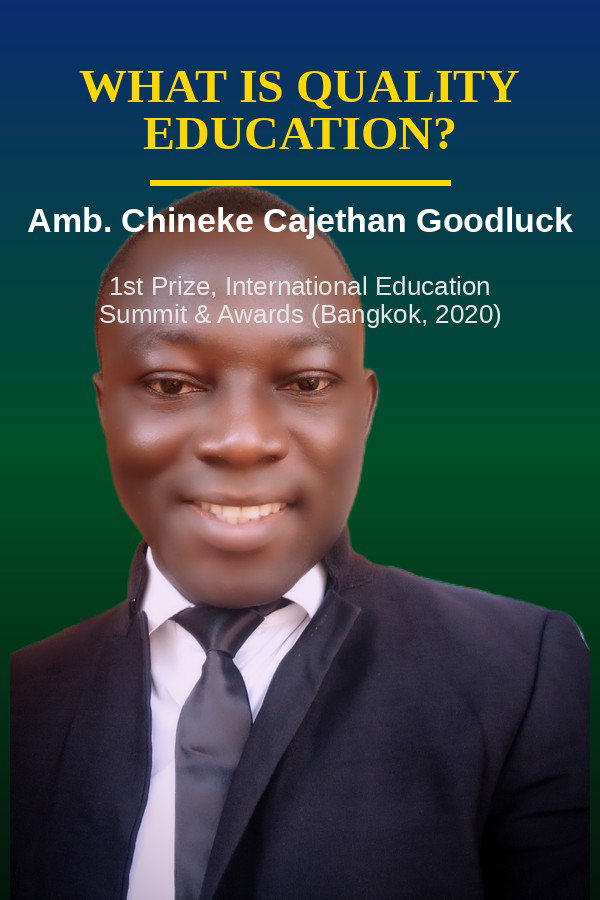
By Amb. Chineke Cajethan Goodluck
Award-winning Essay: 1st Prize, 2020 International Education Summit and Awards (IESA), Bangkok.
Beyond the Grades: Defining Quality
According to UNESCO’s Global Monitoring Report, quality education is not merely about filling seats or achieving high marks. It is the engine of a child’s development, nurturing their creative, emotional, and cognitive capacities. True education is demonstrated by how a child adapts, the depth of their understanding, and the values they carry into society as responsible citizens.
However, a significant gap exists. While global goals like "Education for All" are noble, they often fail to account for the reality in developing nations. Many countries lack the resources to execute these recommendations, leaving the concept of "quality" as a luxury rather than a right.
Rote Learning vs. Meaningful EngagementIn my research, I’ve found that education often falls into two categories: "rote learning and meaningful learning". Rote learning-what Paulo Freire famously called the "banking concept"-treats students as passive empty vessels to be filled with information. They memorise, replicate, and store facts without ever truly understanding them.
In Nigeria, this is a visible struggle. For years, our system has been "content-driven," obsessed with School Certificate results as the sole metric of success. This puts immense psychological pressure on students, turning education into a "rat race" where the goal is to secure a seat in a "star" school rather than to develop one's own aptitude. To achieve quality, we must move toward "Libertarian Education", where teachers and students engage in a dialogue, learning from one another and fostering critical consciousness.
The Digital Divide and the "Hidden Curriculum"
The introduction of ICT, such as the Joint Admissions and Matriculation Board (JAMB) using digital devices in 2014, was a landmark moment for Nigeria. During my work in my hometown of Oji River, I saw how technology could predict a brighter future for the curriculum.
Yet, we must also look at the "Hidden Curriculum"-the unspoken norms, routines, and regulations students learn through socialisation. Is our school system truly a meritocracy? While education should offer equal chances to all, factors like social class, gender, and ethnicity often ruin a student's chances of success before they even begin.
The Myth of Equality: Gender and Access
In many parts of Africa, equality remains a myth. Even where primary education is free, as it has been in places like Mauritius and Nigeria at various points in history, it does not guarantee equal outcomes.
Historically, girls were sidelined as future "housewives" while boys were groomed as "breadwinners." While enrolment rates have improved, deep-seated discrimination remains. In many homes, a daughter's education is still seen as secondary. If we are to achieve "Education for All," we must eradicate gender-based discrimination entirely.
A Personal Plea from Enugu State
Quality education requires more than just policy; it requires humanity. During my visits to places like the Community School Nkwuli Awlaw in Oji River, I have seen children learning in dilapidated buildings, their teachers crying out for help. How can a child gain skills in an environment that is falling apart?
Achieving quality education is an expensive, collective burden. It requires a high reading culture, fair remuneration for teachers, and a commitment to the underprivileged and orphaned. This is why, in 2013, my colleagues and I founded the United Organisation for Education and Sports Development. We believe that our future is in our hands. As the philosopher Martin Heidegger suggested: we are what we make of ourselves.
Conclusion: A Shared Responsibility
Quality education is everyone’s business. It is not just a personal issue or a government mandate. The elders represent our foundation, the youths are our present, and the children encapsulate our future. If we do not fix the foundations today, the structure we build tomorrow will surely collapse.