The River that Remembers
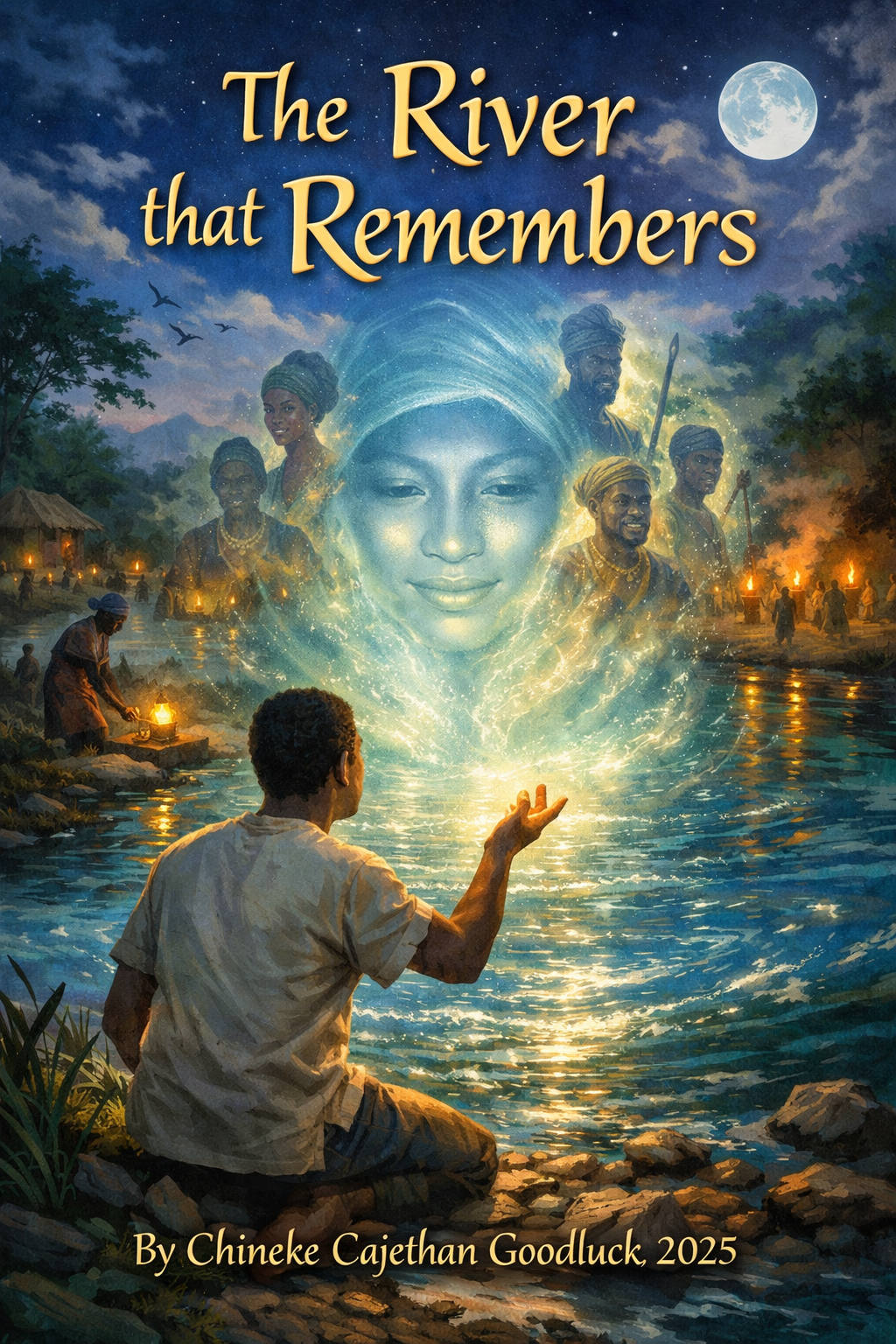
By Chineke Cajethan Goodluck
They tell our grandparents it came into being when our grandparents' mothers were still babies. That it bears every name ever spoken on its bank. Ọmị, which is the Yoruba one they use to call it. Kogi ruwa, the Hausa people refer to it as. My people, where Anambra and Anambor are a hair's breadth apart from one another, we just call it Mmiri Ndụ—the river of life, the river of memory.
I once knew it as a kid. My grandmother took hold of me one evening on the riverside. "Listen," she whispered, her voice as soft as palm oil. I knelt, ear over water. There was racing first only. Then whispers, as if drums had been wrapped up in distance, as if children's as-yet-laughter.
"Mum's name the river knows," she told me. "And if you're a fool, then sooner or later it'll bellow it out."
I had smiled. I was seven years old, and I assumed she was speaking myth. But I awakened the following morning running a temperature, and the river whispered to me quietly back: Chineke, come closer. I said nothing.
Our village lay around the river curve. There the fishermen sang:
Mmiri, gel n
Buru kwongwo nyiri gaa n
Gals washed the wrappers in the shallows and spoke Pidgin: "This water know more secret than juju man." Children played, innocent, until it got dark, then the old people cautioned us the river got mirror to ghosts.
My grandmother taught the rituals to me. A bird, a kola nut, and a cup containing palm oil left alone at its corner as the planting time arrived. "We feed the water," she said to me, "so the water feeds us."
My brother Chike never was afraid. "I'll swim to the middle and yell my name!" he exclaimed one afternoon. I wished I could too, but Grandma just shook her head. "Patience. The river waits. It will teach you."
We'd spend afternoons wading through the reeds, investigating the juxtaposition between the current's fish, and birds high up on the riverside. I recall the tappy-tap of the rainwater off leaves, the wet-muddy odor, and the children's giggles as we watched the paper-constructed boats float downstream.
Grandmother called us by name, calling them, each after each, traders, hunters, warriors. "They live in the river, in wind and water," she said. "In case you forget them, the river will remind you."
Chike once asked, "Will the river be calling us too?"
Grandmother smiled. "It will. But only after you're ready to hear."
That evening, on the mat, beneath the rain outside, the river voice said my name, running through the hills, running through the villages, running through the people I do not know, bearing all that has been said on the rivers.
I would rise with the dawn, along with the gentle creaking of the river, Chineke…Chineke… and think, for a little while, that it was calling me, telling mysteries of an older world than the village, older than my grandmother.
It saw it all: mothers hiding children from marauders, lovers making promises, traders traveling between kingdoms. It gently flowed past each life, and each life gently flowed past it as well.
One morning, I had some elders reciting around the bank:
One who lacks rivers, ranti gha g
I am so worried about where you originated.
(The one of the river, remember your name
Most important, if you're aware where exactly you're coming from)
I reclined on the water and cupped my ear. It answered, low and rolling, for the first time since the accident: Yes…remember…bear it….
I thought that then, perhaps for the first time, as if the river was, then, conscious, and watched, that it would some day pose me a question that I did not know.
River current pulled at my ankles as if saying: I am older than you, yet I shall instruct you.
Smoke was up there. Rumors moved as fast as soldiers' legs: there would be war. Our laughing crowd was silent. Children no longer ran around the river. Women no longer sang as they washed wrappers. Even the elders moved quietly.
Chike and I hid behind the reeds. "They'll take our names if they catch us," he whispered. "They'll forget us." I shivered, taking his hand. I did not know what to do. The river, so full-voiced normally, strained that evening, the darker-than-normal-water echoing the smoke-filled skies.
Grandmother was beside the fire, nutshelling, praying. "The river knows," she said. "It takes the names of the lost ones. It takes them, even when we cannot."
Night descended, the soldiers arrived. Lanterns drifted above, specters. They wailed in foreign tongues, heels crushing scorched earth. Chike pulled on my arm, and we ran into the reeds, racing heartbeats. The river growled by moonlight, soft-muttering: Do not forget me…do not forget.
Villagers awoke the next morning to destruction. Houses had been destroyed. Smoke carried the pungent smell of burn on the breeze. And Chike—my shadow, my friend, my brother—was gone. As clues left behind, there was nothing beyond his sandals on the riverbank. I knelt on the riverbank, the river splashing off the tips of my fingertips, as if the very river refused to calm me.
I would never forget him, I said. The river answered back with a silent whirlpool, the waves of the ripples unfolding outward as if taking my vow away to distant foreign lands.
The next days were gloomy. Mothers mourned over sons who never came back. Children feared to emerge from the reeds. The river that accompanied us as we came along now looked burdened with suffering. Its formerly sparkling waters were congested with trash, sticks, and ash-leaves.
Grandmother's stories got darker, stories about the people the colonizers took, about epidemics, about betrayal. "Rivers remember," she told me, "even when people forget. Rivers will carry your names until you come back."
I would sit for hours on the knees in the stream, listening, learning. It would whisper, it would sing. It would whisper this way, in Hausa, this way: Ruwa yana tuna duk wanda ya taɓa shi. The water remembers all who touch it.
I saw once a man across the river, a man I never met. He knelt among the reeds, watching, quiet. I shouted, "Who are you?" He was gone before I could look. The river foamed under my feet, answering: I watch, I remember, I bear.
It wasn't the same village. There were troops arriving and departing. There were burned homes. There were destroyed markets. Even the peripheral church wasn't any insurance against the devastation. But still the river stood.
Its waters testified to us about courage, about mothers who had accommodated children, about lovers who had passed love messages downstream. It was our teacher, our witness, our evidence that life, even after the destruction, persevered.
Grandmother came up behind me once. "Your brother, do not forget him," she said. "Carry his name as I carried the names of my parents, as your people carried the names of their people. Take the river. It will protect you. Listen."
And I did. I began to set to paper what the river was whispering. Names, whispers, warnings, and tales came to mind as the very river flowed. I wrote them some times, I sang them some times, hoping the river would propagate them beyond our village, beyond the war.
I had known the mood of the river by the time I was twelve years old: it was playful in sunshine, serious in storms, angry when humans destroyed what it loved. I began to teach younger kids to listen, to sit on its shore and have memory move through them. "Remember," I said, "the river remembers all names. Your name, your parents' names, my brother's name—all that is here."
They came back that year. They starved, raided villages, pillaged houses. People fled. The river growled through the nights, turning up trash, pulling up trees. And I heard, through the growl, the voice of Chike: Remember me. Bear our name.
I could not see him, yet I knew that he was there, in the sea. I said it aloud this time: "I will. I will carry your name, brother. I will make them never forget us. Not now, never."
The river murmured back, gentle and unyielding: Yes. Remember. Carry.
War introduced me to the meaning of fear, hunger, and despair, but it taught me something even better: that names are a source of holiness. Losing a name would be the equivalent of losing life. And the river, so enduring, so tenacious, saw to it that no name, including that of my brother, was ever lost.
I wasn't fifteen when there came to the village a new kind of threat. Suits came, speaking English and Hausa, bringing papers, maps, and strange machines. They were oil people. Their lorries growled over the fields like beasts, consuming roads and fields. The river, formerly merry and unconfined, was glum among them.
"Development," they said. "Progress." We watched what they brought: whipping pipes, digging the ground to splinters, and the black matter they claimed would enrich the kings. The river growled. Fish came up dead, the reeds stood crook-wise, the water ceased to sparkle in the sun.
The Lagos pastor followed, wagging his finger in the direction of the water. "This river is a black altar!" he thundered. "Destroy it, and the Lord will bless you! Do not destroy it, and you welcome evil!" The villagers, unable to tell who was lying, doused the riverbank with diesel and set light to kola nuts in a mad flurry.
I ran the entire distance back to the river that night, heart full. Its current flowed, the black waters rippling like the golden hour. I waded into the river. "Do I need to make them forget?" I asked.
The river foamed at my feet. Its voice was deep, bass, almost thunder: Idan ka yi shiru, za mu mutu tare. If you keep quiet, we will perish together.
I dreamt that evening that I was inside a hall of water. There were thousands of bodies shining: the vanished villagers, the abducted children, the hushing mothers among the reeds, the tender lovers who had sworn love. My brother Chike came, tall, shining-eyed. "You bear our names," he said. "Fear not."
I arose with fever and perspiration, but with resolve. I arose the following morning to go see the old people. "We cannot let them say the river is theirs," I told them. "It has our past, our living, people who came before us." Others concurred. The rest, intimidated by the soldiers, kept quiet.
The following weeks were strained. Men who worked for the oil company began to build a pipe line. Bulldozers growled, tearing up trees, leveling the ground. Soldiers followed behind, shouting instructions, waving guns. Women cried, children shrieked, and the river foamed, bubbling, as if it too was trying to do them harm.
I called the children to me. "We don't battle bullets," I explained. "We battle names, names that wound, names that hurt, names that mar memories."
We also created a daily routine: chanting, singing, reciting the river name in Igbo, Yoruba, Hausa, Pidgin. There were melodies accompanied by long, serpentlike verbal narratives.
Onye arụ arụ agụ
Emiri wé ndé azù.
It is you, it is you, it is you…
They didn't know the soldiers or the oil workers. Nor the villagers. But the river comprehended. Its waters flowed, now quietly washing up around the hulls of the bulldozers, now foaming like a storm, as it were, to overturn the machinery.
There was a little girl on the riverbank that morning, shivering. "Will it keep us safe?" she whispered. I smiled, putting my hand over the back of hers. "It always has," I said. "But only if we remember, only if we call aloud their names, and ours."
I encountered the pastor that evening by the river. He clutched a bible in his shivering hands. I saw fear in his eyes the first time. He prayed humbly, yet the river would not listen to him. Its remembrance was for the people, the children, the ancestors.
The nights were long. We shouted, we danced, we screamed our names. In each chant, each song, each quietly told tale, we could feel the recall of the river, reminding it that we were there, it could not go away.
One evening, once the moon was full, the river responded back in many voices. Whispery ones, harsh ones, ones that were demanding: Do not forget. Remember the names. Preserve the things that are sacred.
I could feel the touch of Chike, next to me in the river, prompting me to hold to the deal. Currents in the rivers carried his laughter, and I too laughed, beyond fear, beyond soldiers and machinery and diesel.
The elders arrived. "Our young people have returned the river to us," they said. "With song, with remembrance, we battle without bullets."
And the river answered. A burst of wave, not to destroy, but to protect. Bulldozers came to a stop, machinery was engulfed, and the oilmen retreated under the power of water and song. The soldiers were taken aback and stumbled. No one was hurt. Only the river, vast, backward, victorious.
I knelt one evening and listened. The river itself carried so many languages: Igbo, Yoruba, Hausa, Pidgin, English. All the names that had ever been called to it churned in the waters. All the lives that had ever been born off it—my brother's, the mothers', the children's—was safe, for the time being.
We had learned something essential: voice and memory are stronger than steel and flame. It had carried us, as it always did. And we carried it back home, worshipping it, singing to it, remembering it in every breath.
In the subsequent nights, once the river returned, the nights were subdued ones and they were protracted, yet they were not lifeless. I could feel the passage of the water, through reeds, through sand, even soles of me. It was an ongoing vibration, in voices that were older than my nanny, older than the village.
I began to dream in vibrant color. I dreamt that I transported myself over a river of currents and ancestors came up from the waters. They shone, attired suited to their era: traders in beads, warriors wearing spears, mothers rocking babies. They summoned me in tongues I did not know to speak but did in my bones: Igbo, Yoruba, Hausa, English, and whispers I could not vocalize.
"Carry our names," they ordered.
Recall the river," they advised me.
"Do not let them forget."
Another dream, Chike in it. Older, smiling wide, sly eyes. "The river saved us," he instructed me. "And now you have to save it in return."
I awoke to the taste of the salt on the lips, droplets of sweat on the mat. Then the river's call followed me into the living.
I was seventeen years old. I called the children around the river, I called upon them to listen, to call them by name, to call the names of their ancestors, to sing to the river.
"MMiri comprehends us," I told them. "It remembers the past, keeps the present, and looks into the future."
They splashed around. Then, some time afterwards, they chanted thus in Igbo:
Mmiri, jiri nwayọ…
The Yoruba children chorused back:
Ọmọ omi, gba orukọ wa…
Hausa voices cried out in:
Ruwa, we have your…
Even the pastor, who had sworn against the river before, came by one morning. He stood on the banks, grasping his Bible, and muttered prayers of deference. "Maybe I was wrong," he said, "maybe faith and memory are here, in some ways that I do not understand."
The children's voices became loud, clear, until the river itself answered. Its water shone in the sunlight, played with its waves, and its current bore the songs downstream, far from the village, far from the hills.
They're forgetting the river, I thought. I stood in front of a small boy in the dream. "Mo jẹ́ ọmọ omi," he whispered. "I am the child of the water. They're forgetting me. If they forget long enough, I'll leave. And once I've left, the earth will grow dry."
I leaped up in terror, heart pounding. The face of the river foamed up in indignation, as if defying the threat of the child. I recognized that the recollection would be insufficient to save the river. Something must be done.
I struggled to instruct the villagers to protect it in a utilitarian way: reforestation on its banks, filtration of its waters, resisting industrial encroachments, and imparting each new-born child the stories. With every ritual, every story, every gentle whisper of a name, the power, the memory, the existence of the river were fulfilled.
Years went by. The village recovered, inch by inch. Again the sun shone on the river waters. Fish swam again. Children played. Women washed their clothes as they sang Pidgin: "Sabi secret pass sabi man dis water juju."
This river was living history to us, to our people, to our pain, to our hopes. I had discovered the river's secret strength: it wasn't the water. It was remembrance. It was testimony. It was life.
One afternoon, a young man approached the river skipping stones. "Ọ bụ gị?" he dared me.
"M bụ onye nke mmiri," I said.
He rested his head, then murmured quietly in Yoruba: Mo jẹ́ ọmọ omi. But I'm being forgotten by mankind. If they think about me too long, I shall be no more. And if I'm no more, the earth shall be dry.
I placed my hand next to his, listening to the beating of the water beneath us. "We will remember. We will recount. We will sing."
The river churned around us, radiated. It was deep and almost terrifying in its growl: Yes. Remember. Bear.
And now that I go to far-off metropolitan capitals—Abuja, Lagos, London, Kingston, Delhi—the river follows me in word, in mind. I tell children, students, strangers:
"The river doesn't care where you come from. It says to people: will you remember me? If people don't, deserts will rise. Fish will die. Even your own name will be lost."
But if you recall, if you kneel, if you sing, if you whisper, the river replies. It says your name.
In their depths, I am hearing the names on the other banks: mothers, rebels, farmers, lovers, unborn children. We don't own the river. It belongs to whoever remembers. whoever remembers.
I stand on the riverbank, I lift up my hand to the river, and I declare: "We shall remember. We shall remember all names." And the river, unfathomable, shining, living, answers back in a whisper: Because I remember. Because I know. Because I never die.